

Social media can put a business in front of potential customers long before they are ready to buy.
Someone may discover a company through a short video, see a useful post several days later, visit its profile to learn more, and eventually search for the business on Google before making a decision.
That makes social media more than a place to publish posts.
It can help a business build awareness, demonstrate expertise, develop trust, generate conversations, and support conversions.
But simply having an active social media account does not automatically produce business results.
Posting without a clear purpose, trying to maintain every platform, focusing entirely on follower growth, or publishing promotional content repeatedly can create activity without creating meaningful progress.
Social media marketing involves using social platforms strategically to reach target audiences, distribute content, build relationships, promote products and services, and support broader business objectives.
Common activities include organic content, paid advertising, community management, short-form video, educational content, promotional campaigns, performance marketing, and ongoing measurement.
This guide explains how social media marketing works, how to choose the right platforms, how content supports different business goals, how social media fits into the customer journey, which metrics matter, and how it can work alongside SEO, Google Ads, and a business website.
What Is Social Media Marketing?
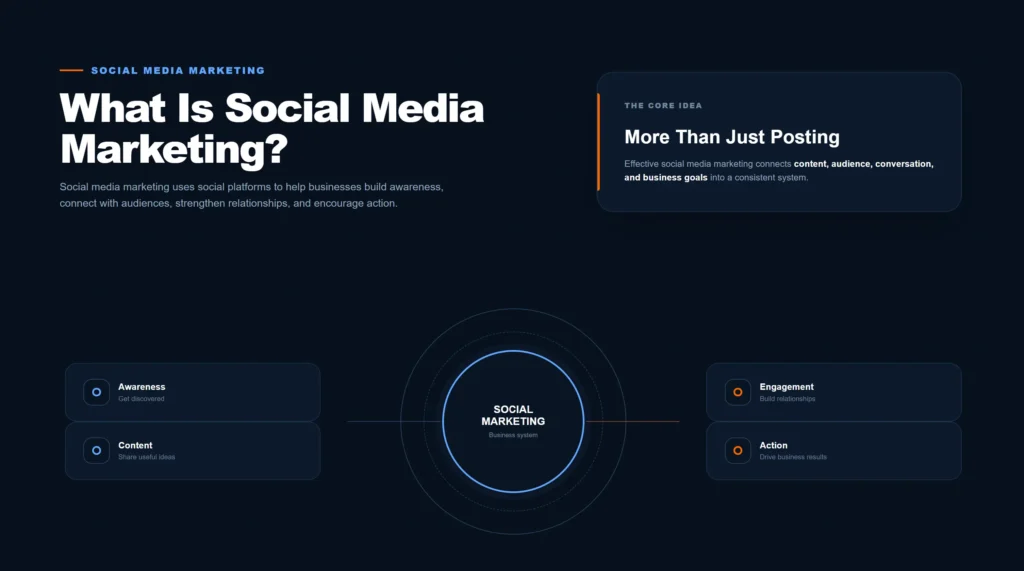
Social media marketing is the use of social media platforms to reach audiences, distribute content, build relationships, promote products and services, and support business goals.
Depending on the business, social media marketing can involve:
- Content creation and publishing
- Audience research and targeting
- Organic social media
- Community management
- Paid social advertising
- Social media campaigns
- Performance marketing
- Measurement and reporting
The specific approach depends on the business, its audience, its products or services, and what it is trying to accomplish.
A local business may use social media to remain visible within its community. An e-commerce company may use it to showcase products and generate purchases. A B2B company may use social platforms to demonstrate expertise and build relationships with potential clients.
Social Media Marketing vs. Simply Posting
There is a difference between maintaining a social media profile and having a social media marketing strategy.
Simply posting might mean publishing content whenever something comes to mind.
Social media marketing starts with a purpose.
A business might publish content to:
- Introduce a service or product
- Answer a common customer question
- Demonstrate expertise
- Build trust
- Drive website traffic
- Generate leads
- Support an advertising campaign
The post itself is only one part of the process.
The business also needs to consider who the content is for, why it is being published, what action it should support, and how its performance will be measured.
What Does Social Media Marketing Include?
Social media marketing can involve several functions, each serving a different role within the wider strategy.
Content marketing focuses on creating useful, educational, entertaining, or persuasive content.
Community management involves responding to comments, messages, questions, and other audience interactions.
Paid social advertising uses social advertising platforms to reach defined audiences and support specific campaign objectives.
Social media management involves the ongoing planning, publishing, monitoring, and maintenance of social profiles.
Performance marketing focuses more heavily on measurable actions such as leads, purchases, conversions, and campaign efficiency.
These functions are related, but they are not interchangeable. A business may need content creation and community management to maintain its organic presence, while paid social and performance marketing may support measurable acquisition goal to the wider marketing system.
How Social Media Marketing Works
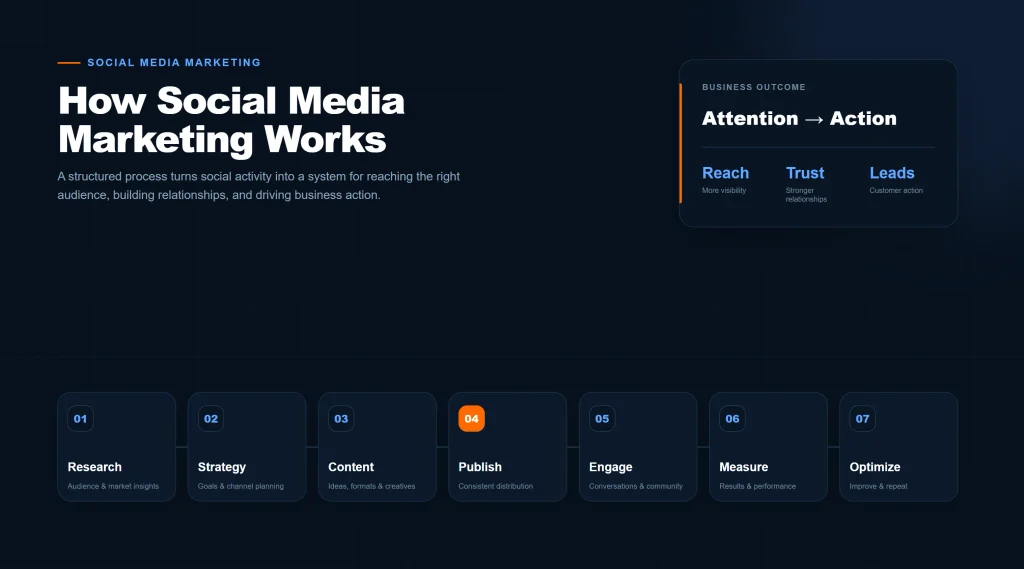
Social media marketing works through a cycle of planning, creating, distributing, engaging, measuring, and improving.
The process may look simple from the outside because users mainly see the finished posts and advertisements. Behind those outputs, however, effective social media marketing involves research, strategic decisions, content development, audience targeting, and ongoing performance analysis.
Understand the Audience
The first step is understanding who the business is trying to reach.
Audience research can help identify:
- Customer needs
- Common problems
- Questions
- Interests
- Buying motivations
- Objections
- Preferred platforms
- Content preferences
A business should not assume that everyone on social media is part of its target audience.
The objective is to identify the audiences most relevant to the business, understand their needs, and determine what information may influence their decisions.
Define Business Goals
Social media activity should connect to a measurable business objective.
Goals can include:
- Increasing awareness
- Building an audience
- Generating website traffic
- Increasing inquiries
- Generating leads
- Promoting products
- Supporting sales
- Building customer relationships
Different goals require different content, platforms, campaigns, and measurements.
For example, a campaign designed to increase awareness may focus on reach and video views, while a lead-generation campaign may focus on completed forms, qualified inquiries, or cost per lead.
Choose the Right Platforms
Businesses do not necessarily need to be active on every social platform.
Platform selection should consider:
- Where the target audience spends time
- What type of content the platform supports
- The business model
- Available resources
- Campaign objectives
Platform popularity alone does not make a network suitable for every business. Being active on fewer platforms with a clear strategy can be more effective and manageable than spreading resources across every available network.
Create Relevant Content
Once the audience, goals, and platforms are understood, the business can develop content around specific themes and content pillars.
Content may educate, demonstrate, entertain, answer questions, showcase products, explain services, or encourage an action.
The important part is that each piece of content has a reason for existing and supports a broader business or marketing objective.
Publish and Distribute
Publishing is the point at which content becomes visible to the audience.
Distribution can include:
- Organic publishing
- Stories and short-form video
- Community posts
- Paid advertising
- Influencer or creator collaborations
- Cross-platform distribution
The distribution method should match the content, audience, platform, and objective. A piece of educational content may be distributed organically to an existing audience, while a product-focused campaign may also use paid promotion to reach a defined target audience.
Engage With the Audience
Social media is different from many traditional marketing channels because people can respond directly.
Comments, messages, questions, mentions, reviews, and discussions can all provide opportunities for interaction.
Responding to relevant interactions can help businesses understand their audience, answer questions, address concerns, and develop stronger customer relationships.
Measure and Improve
Publishing content is not the final step.
Businesses should review performance and identify which activities are contributing to useful results.
This can involve looking at:
- Reach
- Engagement
- Video views
- Website traffic
- Leads
- Conversions
- Cost per result
- Revenue
- Return on ad spend (ROAS)
The objective is not simply to identify which post received the most likes.
It is to understand which activities are contributing to the business objective and use those insights to improve future content, targeting, campaigns, and resource allocation.
ROAS should also be interpreted carefully because it measures revenue generated relative to advertising spend and does not, by itself, represent profit.
Organic vs Paid Social Media
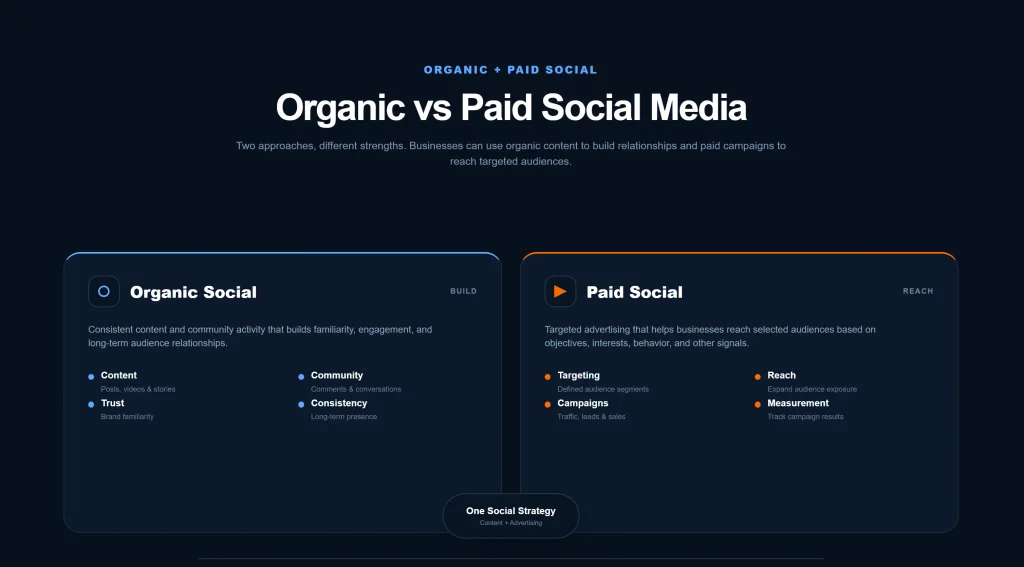
Social media marketing can involve both organic and paid activity, with each serving a different role within the overall strategy.
What Is Organic Social Media?
Organic social media refers to content and interactions distributed through a business’s social profiles without paying for that specific distribution as an advertisement.
Examples include:
- Regular posts
- Stories
- Reels
- Educational content
- Product updates
- Community interactions
- Comments
Organic activity can help businesses build familiarity and maintain an ongoing relationship with their audience.
However, organic distribution is not guaranteed to reach every follower or potential customer.
What Is Paid Social Media?
Paid social media uses advertising systems to distribute content or offers to selected audiences.
Businesses can use paid campaigns for objectives such as:
- Awareness
- Traffic
- Engagement
- Lead generation
- App promotion
- Product sales
- Conversions
- Retargeting
Paid campaigns can provide greater control over audience targeting, budget allocation, placements, and campaign objectives.
Organic and Paid Social Working Together
A balanced social media strategy can use both organic content and paid campaigns, with each serving a different purpose.
Regular content can help establish a brand’s messaging, understand audience responses, and build a library of useful creative assets. Paid campaigns can then extend the reach of selected content, target specific audiences, and support campaigns with defined business objectives.
For example, a business may publish educational content organically, identify topics that generate meaningful engagement, and then create paid campaigns around a relevant offer.
However, strong organic engagement does not automatically mean that a post will perform well as a paid advertisement.
The approach should depend on the business objective rather than assuming that every post should be promoted.
Choosing the Right Social Media Platforms
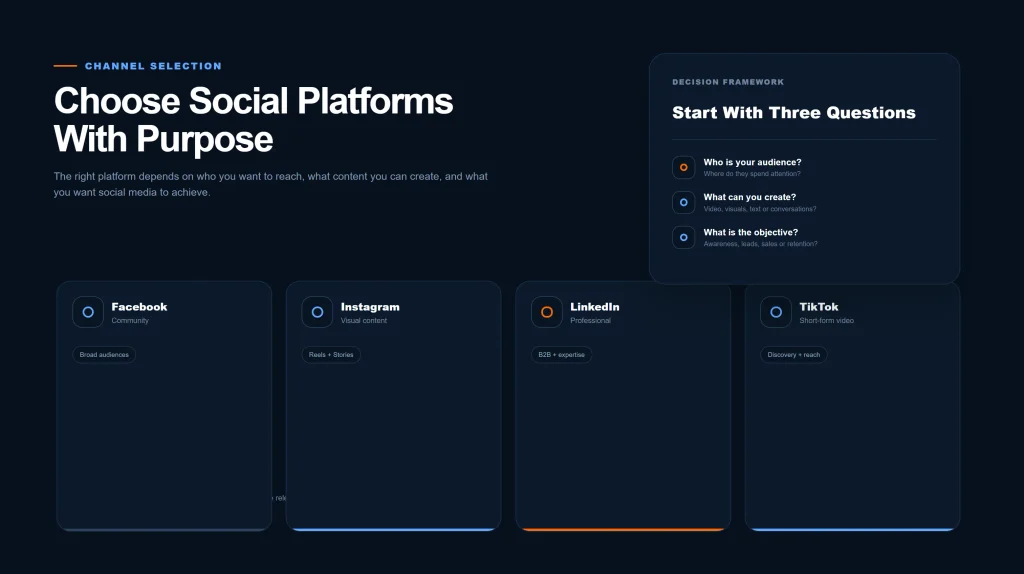
There is no single social media platform that is automatically right for every business.
The right choice depends on the audience, business model, content format, resources, and objectives.
Facebook can support a wide range of business activities, including community building, content distribution, advertising, local audience engagement, and customer communication.
It can be particularly useful when a business needs a combination of organic content and paid advertising.
Instagram is strongly visual and supports formats such as images, Stories, Reels, carousels, and other visual content.
It can be particularly useful for businesses that can communicate their value visually through:
- Visual products
- Short-form video
- Creative work
- Demonstrations
- Lifestyle content
- Brand storytelling
LinkedIn is centered around professional and business-oriented networking.
It can be relevant for:
- B2B companies
- Professional services
- Consultants
- Agencies
- Recruiters
- Business leaders
Content can focus on expertise, industry knowledge, company developments, professional insights, business problems, and supporting B2B lead generation.
TikTok
TikTok is heavily focused on short-form video and discovery.
Businesses that can communicate effectively through fast, engaging video may find opportunities on the platform.
The content approach usually needs to match the platform’s viewing behavior and creative conventions rather than simply reposting long-form promotional material.
YouTube
YouTube supports longer-form and short-form video content.
Businesses can use it for:
- Tutorials
- Product demonstrations
- Educational videos
- Reviews
- Explanations
- Brand content
- Search-driven video discovery
Video content can also provide useful material that can be repurposed across other channels.
X (Twitter)
X can be useful for real-time discussion, commentary, news, industry conversations, and direct communication.
Its value depends heavily on whether the business and its target audience actively participate in those conversations.
Match the Platform to the Business
Different platforms can be more suitable for different types of businesses, content, and objectives.
- Visual products and lifestyle brands → Instagram, TikTok
- B2B and professional services → LinkedIn
- Tutorials, education, and demonstrations → YouTube
- Community-focused or local businesses → Facebook
- Real-time industry discussion → X
These are starting points rather than fixed rules. Audience behavior, content capabilities, resources, and business objectives should determine the final platform mix.
How to Choose Platforms
Instead of asking:
“Which social media platform is best?”
Businesses should ask:
“Which platforms give our business the best opportunity to reach the right audience and achieve our objectives?”
That distinction matters.
A platform with a large overall user base may still be a poor fit if the business’s target audience is not active there or if the required content format does not match the company’s capabilities.
Social Media Content Strategy
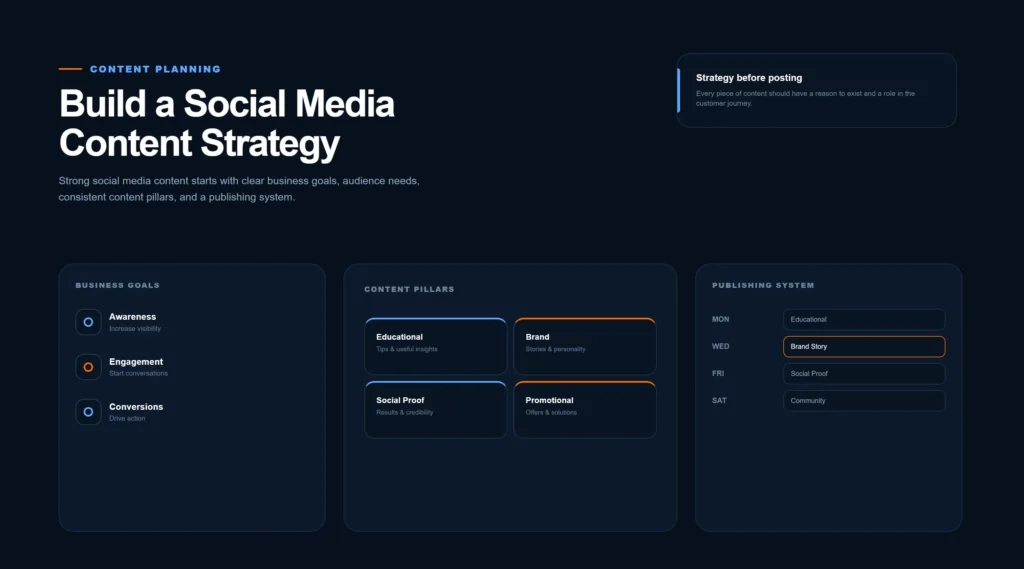
A social media content strategy defines what a business publishes, who it is for, why it is being published, and how it supports the wider marketing strategy.
Without a strategy, businesses often fall into a repetitive cycle of promotional posts.
Define the Purpose of Your Content
Every content strategy should begin with a clear understanding of what the content needs to accomplish.
Content may be designed to:
- Attract attention
- Educate
- Build trust
- Demonstrate expertise
- Showcase products
- Explain services
- Drive traffic
- Generate leads
Different posts can have different purposes.
Not every post needs to generate a direct sale.
Understand What the Audience Needs
Effective content starts with audience needs, customer problems, and the questions people ask before making a decision.
Businesses can identify content opportunities by examining:
- Frequently asked questions
- Customer objections
- Product questions
- Search behavior
- Sales conversations
- Customer feedback
- Common industry problems
This provides a stronger foundation than simply asking, “What should we post today?”
Create Content Pillars
Each pillar should connect to a relevant audience need, content objective, or business topic rather than existing only as a publishing category.
For example, a digital marketing agency might use pillars such as:
- SEO education
- Paid advertising
- Website strategy
- Case studies
- Marketing insights
- Business growth
Content pillars help maintain consistency without requiring every post to repeat the same message.
Match Content to the Objective
Different objectives can require different types of content.
Awareness-focused content may introduce a problem, explain a concept, or reach new audiences. Consideration-focused content can demonstrate expertise, answer objections, compare options, or provide social proof. Conversion-focused content can present an offer, explain a service, or encourage a specific action.
Mapping content to its intended objective helps prevent a strategy from becoming a collection of unrelated posts.
Build a Content Calendar
A content calendar organizes upcoming content and provides visibility into what is being published.
It can include:
- Topic
- Platform
- Content format
- Publishing date
- Content objective
- Creative requirements
- Call to action
- Status
The purpose of a calendar is not to make social media rigid.
It provides a system that makes consistent publishing easier to manage.
Balance Promotional and Non-Promotional Content
If every post tells people to buy something, the audience may have little reason to continue engaging.
A stronger content strategy can combine:
- Educational content
- Useful information
- Demonstrations
- Social proof
- Brand content
- Promotional offers
The appropriate balance depends on the business and its audience.
The goal is not to avoid promotion. It is to make promotional content more relevant by connecting offers to the audience’s needs, problems, and stage in the decision-making process.
Repurpose Content Across Platforms
A strong piece of content does not necessarily need to exist in only one format.
A detailed article can become:
- A short video
- A carousel
- Several educational posts
- A series of Stories
- A visual summary
- A discussion topic
Each platform has different formats, audiences, and consumption patterns, so the core idea may need to be adapted rather than copied directly.
For example, a detailed article might become a short educational video for TikTok or Instagram, a professional insight for LinkedIn, or a longer explanatory video for YouTube.
Content Types That Support Different Goals
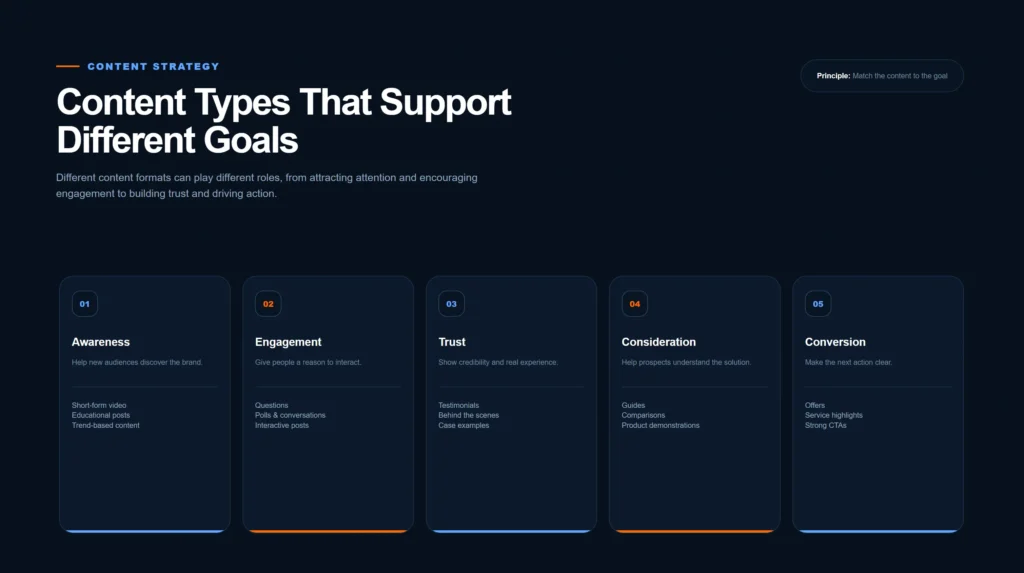
Different types of content can support different stages of the customer journey.
Educational Content
Educational content explains concepts, answers questions, and helps the audience understand a problem.
Examples include:
- Guides
- Tips
- Explanations
- Tutorials
- Industry insights
Educational content can help establish expertise, answer questions, and move potential customers toward a better understanding of the problem before a purchase decision.
Product and Service Content
Businesses also need content that clearly explains what they actually sell.
This can include:
- Product features
- Service explanations
- Benefits
- Use cases
- Demonstrations
- Pricing information where appropriate
Clear product and service content helps potential customers understand what is being offered, who it is for, and how it may address their needs.
Demonstration Content
Demonstrations show a product or service in action.
Examples include:
- Product demonstrations
- Before-and-after processes
- Software walkthroughs
- Service workflows
- Tutorials
Demonstration content can make a product, service, or process easier to understand than a purely promotional message.
Case Studies and Results
Case studies can provide context around how a product or service helped solve a real problem.
They can include:
- The original challenge
- The approach taken
- The implementation
- The outcome
- Lessons learned
Claims should be presented accurately and supported by appropriate evidence.
Testimonials and Social Proof
Customer feedback can help potential buyers understand other people’s experiences.
Social proof can include:
- Reviews
- Testimonials
- Customer stories
- Ratings
- User-generated content
Businesses should present customer feedback accurately and avoid manufacturing, altering, or exaggerating claims.
Short-Form Video
Short-form video can communicate information quickly and visually.
It can be used for:
- Educational explanations
- Product demonstrations
- Quick tips
- Behind-the-scenes content
- Brand storytelling
- Frequently asked questions
Short-form video can support different objectives depending on its topic, creative approach, and call to action.
The format should support the message rather than becoming the strategy itself.
Visual and Graphic Content
Graphics can make information easier to understand or give a business a recognizable visual identity.
They can include:
- Infographics
- Data visualizations
- Quote graphics
- Educational carousels
- Product graphics
- Service explainers
Behind-the-Scenes Content
Behind-the-scenes content can show the people, processes, environment, or work involved in delivering a product or service.
This type of content can make a business more understandable and transparent while giving audiences additional context about the people and processes behind the offer.
Interactive Content
Interactive content can encourage people to participate rather than simply consume information.
Examples include:
- Questions
- Polls
- Surveys
- Quizzes
- Discussions
- Q&A sessions
The objective should still connect to the audience and business rather than creating interaction for its own sake.
Building a Balanced Content Mix
A social media strategy does not need to rely on one content type. Educational content can attract and inform audiences, demonstrations can show how an offer works, case studies and testimonials can provide evidence, and product or service content can support conversion.
The right mix depends on the business, audience, platform, and objective. A content strategy should therefore prioritize useful combinations of content rather than trying to follow a fixed posting formula.
Social Media and the Customer Journey
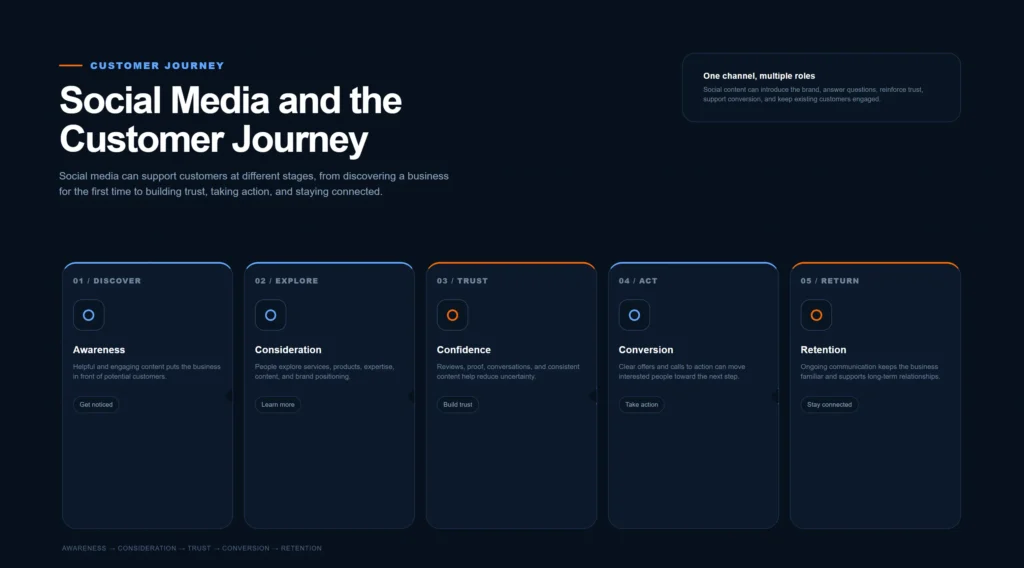
Social media can support different stages of the customer journey, from initial awareness to consideration, conversion, and ongoing customer relationships.
Someone discovering a business for the first time has different needs from someone comparing providers or someone who is ready to purchase.
Awareness
At the awareness stage, people may not know the business exists.
Content can introduce:
- The brand
- Its products
- Its services
- The problems it solves
- Its expertise
The objective is to introduce the business and establish relevance with potential customers.
Consideration
Once someone becomes aware of a business, they may begin researching whether it is relevant to their needs.
Content can help by providing:
- Educational information
- Product details
- Service explanations
- Comparisons
- Demonstrations
- Answers to common questions
Trust
Trust can influence decisions throughout the customer journey, particularly when potential customers are evaluating whether a business is credible and capable of delivering what it promises.
Trust can be supported through:
- Case studies
- Reviews
- Testimonials
- Demonstrations
- Useful educational content
- Transparent business information
Conversion
At the conversion stage, the audience may be ready to take an action.
The action could be:
- Visiting the website
- Sending a message
- Requesting a quote
- Booking a consultation
- Purchasing a product
Social media can provide the entry point, while a website, landing page, booking system, or direct conversation may handle the next stage of the conversion process.
Retention and Advocacy
Social media can also remain useful after someone becomes a customer.
Businesses can use it to:
- Share updates
- Provide useful information
- Maintain relationships
- Encourage customer participation
- Highlight customer stories
Satisfied customers may also contribute reviews, referrals, or user-generated content, helping extend the relationship beyond the original purchase.
Matching Content to the Customer Journey
The same type of content does not need to be used at every stage.
Awareness content can introduce a business or problem, consideration content can answer questions and demonstrate value, trust-building content can provide evidence, and conversion-focused content can make the next action clear.
The customer journey is rarely completely linear, so businesses may need content that supports multiple stages at the same time.
Social Media Marketing for Different Business Types
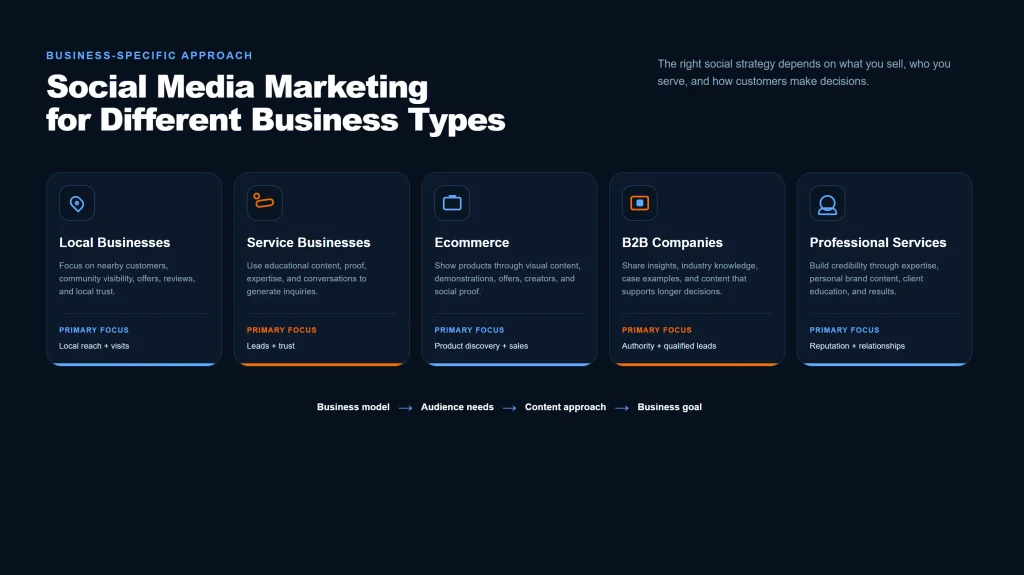
The same social media strategy does not work equally well for every type of business. Audience behavior, buying cycles, sales processes, and the way a business delivers value can all affect the role social media plays.
Local Businesses
Local businesses can use social media to remain visible within their geographic market.
Content may include:
- Products and services
- Local updates
- Customer experiences
- Offers
- Business updates
- Behind-the-scenes content
Social media can also support broader local marketing efforts by giving potential customers another way to discover the business, see customer experiences, and stay familiar with its offers.
For businesses that depend on local search visibility, social media should complement rather than replace local SEO and other local marketing activities.
Service Businesses
Service businesses often need to explain something that cannot simply be placed on a shelf and photographed.
Content can therefore focus on:
- Expertise
- Processes
- Results
- Common customer problems
- Frequently asked questions
- Case studies
The objective is to make an intangible service easier to understand, demonstrate its value, and reduce uncertainty before a potential customer makes contact.
E-commerce Businesses
E-commerce businesses can use social media to showcase products and create demand.
Content may include:
- Product demonstrations
- Product photography
- Tutorials
- Customer content
- New product launches
- Offers
- Reviews
Social media can also support product discovery, retargeting, and repeat purchases when connected with the wider e-commerce marketing system.
B2B Businesses
B2B businesses may have longer buying cycles and multiple decision-makers.
Social content can therefore focus on:
- Industry expertise
- Educational content
- Research
- Business problems
- Case studies
- Company expertise
The objective may be to build credibility, demonstrate expertise, and support the buying process before a sales conversation occurs.
Professional Services
Professional services businesses often sell expertise and trust.
Content can demonstrate knowledge through:
- Educational explanations
- Industry commentary
- Common questions
- Case studies
- Professional insights
The content should help potential clients understand the problem, evaluate possible approaches, and assess the business’s ability to address it.
Agencies and Creative Businesses
Agencies and creative companies can use social media to demonstrate their work directly.
Content can include:
- Project examples
- Creative processes
- Case studies
- Results
- Behind-the-scenes material
- Educational insights
For these businesses, the content itself can become part of the portfolio.
Adapting the Strategy to the Business
These categories are not mutually exclusive. A business may operate across several models—for example, a local service business may also generate leads online, while an e-commerce brand may have a strong B2B customer segment.
The social media strategy should therefore be based on the business’s audience, buying process, offer, and objectives rather than its category alone.
Measuring Social Media Performance
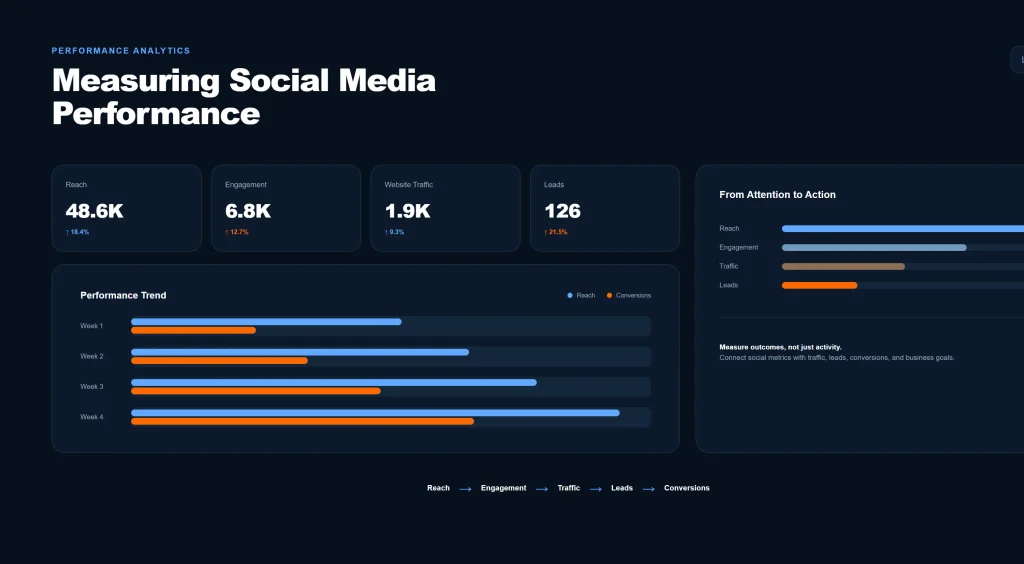
Social media performance should be measured against business objectives rather than vanity metrics alone. The right metrics depend on what a campaign is designed to accomplish, so no single measurement can define performance across every business or campaign.
A large follower count does not necessarily mean that a business is generating customers.
Reach and Impressions
Reach measures the number of unique users who were shown content.
Impressions measure how many times content was displayed.
These metrics can help businesses understand distribution and visibility.
Engagement
Audience interactions can include:
- Likes
- Comments
- Shares
- Saves
- Replies
- Other interactions
These interactions can reveal how audiences respond to different types of content, but they should always be evaluated alongside the campaign’s broader objectives.
A post with high engagement is not automatically a successful business result.
Video Performance
For video content, businesses may monitor:
- Views
- Watch time
- Average viewing duration
- Completion rate
- Engagement
These measurements can help identify whether the content is holding attention and where viewers may be losing interest.
Website Traffic
Social media can send visitors to a business website.
Traffic measurement can help identify whether social activity is contributing to website visits and which campaigns or content are generating those visits.
Leads and Inquiries
For service businesses, a more meaningful measurement may be the number of inquiries or leads generated.
Examples include:
- Contact forms
- Calls
- Messages
- Consultation requests
- Quote requests
Lead quality should also be considered.
UTM parameters and analytics tools can provide additional information about where social traffic comes from and which campaigns are driving visits and conversions.
Conversions
A conversion occurs when a visitor completes a defined business action.
Depending on the business, this may mean:
- Purchasing a product
- Submitting a lead form
- Booking an appointment
- Requesting a quote
- Signing up for a service
Conversion tracking makes it easier to connect marketing activity with business outcomes.
Cost Per Result
Paid campaigns can be evaluated using measurements such as:
- Cost per click
- Cost per lead
- Cost per conversion
- Cost per acquisition
These metrics help businesses understand how efficiently advertising spend is generating the desired result.
Cost per lead and cost per acquisition are not necessarily the same. A lead may become a customer later, so businesses should distinguish the cost of generating an inquiry from the cost of acquiring an actual customer.
Return on Ad Spend
Return on ad spend, or ROAS, compares revenue attributed to advertising with the advertising spend.
For example, if a campaign generates $5,000 in attributed revenue from $1,000 in advertising spend, the ROAS is 5.
ROAS can be useful for e-commerce and other businesses where revenue can be reliably attributed to advertising.
However, ROAS is not the same as profit. It should be interpreted alongside other business costs, margins, customer acquisition costs, and attribution limitations.
Why Follower Count Alone Is Not Enough
Followers can indicate audience size, but they do not tell the complete story.
A business can have many followers and generate very few leads.
Another business may have a smaller audience but generate meaningful inquiries because its audience is more relevant.
The quality and relevance of the audience matter more than a follower number viewed in isolation.
Attribution and Measurement
Connecting social media activity to business outcomes can be more complicated than simply counting clicks or conversions.
Different analytics systems may attribute the same conversion differently depending on the attribution model and tracking setup. Platform-reported conversions, website analytics, and customer records may therefore show different numbers.
Businesses should use consistent tracking methods and interpret social media performance in the context of the wider marketing system rather than relying on a single reporting source.
Common Social Media Marketing Mistakes
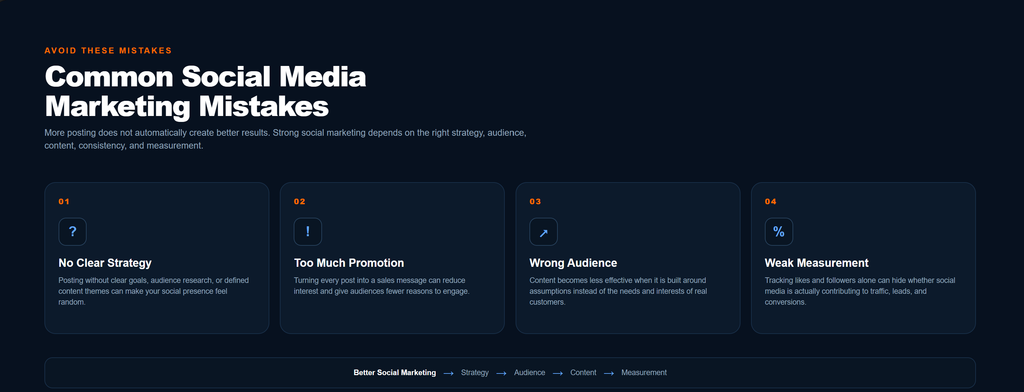
Social media marketing can become ineffective when businesses focus on activity instead of strategy. Common problems include unclear objectives, weak audience targeting, inconsistent positioning, excessive promotion, and poor measurement.
Posting Without a Goal
Publishing content simply because the calendar says it is time to post can create activity without purpose.
Before publishing, businesses should understand what the content is intended to accomplish.
Trying to Use Every Platform
Being present everywhere can spread limited resources too thinly.
Businesses should prioritize platforms where their target audience and content strategy make sense.
Focusing Only on Followers
Follower growth can be useful, but it should not become the primary measure of success.
Businesses should also evaluate audience relevance, engagement quality, website traffic, leads, conversions, and revenue where appropriate.
Publishing Excessive Promotional Content
An audience may not want every post to be a sales pitch.
Useful educational, informative, entertaining, and trust-building content can make promotional messages more relevant when they appear.
Ignoring Comments and Messages
Social media creates opportunities for direct communication.
Ignoring questions, comments, or customer concerns can waste those opportunities.
For businesses that receive customer inquiries through social platforms, response quality and response time can also affect the customer experience.
Inconsistent Positioning
A business should communicate a reasonably consistent identity across its social presence.
Constantly changing tone, topics, visual direction, or messaging can make it harder for audiences to understand what the business represents.
Reusing Content Without Adapting It
Cross-platform distribution can save time, but each platform has different formats and user behavior.
Content should be adapted when necessary rather than automatically copying the exact same post everywhere.
Not Tracking Conversions
If social media is intended to generate business results, those results should be measured.
Without conversion tracking, businesses may know how many people interacted with content but not whether those interactions contributed to meaningful outcomes.
Disconnecting Social Media From the Website
Social media should not always operate as a closed system.
The website can provide deeper information, service details, product pages, case studies, contact options, and conversion paths.
Social media and the website should therefore work as connected parts of the broader marketing system rather than as completely separate channels.
Boosting Content Without a Clear Objective
Paying to distribute a post does not automatically make it a successful campaign.
Paid promotion should have a defined objective, audience, budget, and measurement framework.
How Social Media Works With SEO, Google Ads & Your Website
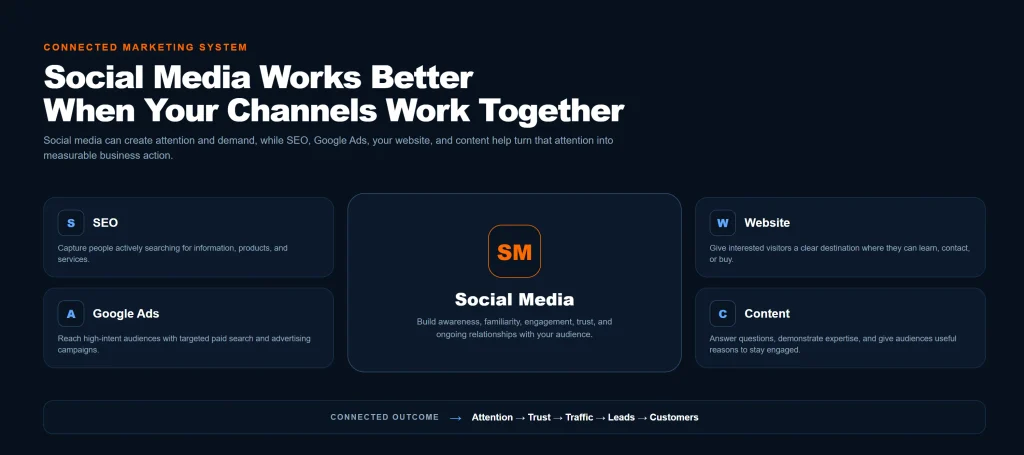
Social media becomes more valuable when it is connected to the rest of the digital marketing system.
A person may discover a business through social media, search for it on Google later, visit the website, read an article, click an advertisement, and eventually become a customer.
The channels may have different roles, but they can support the same customer journey.
Social Media and SEO
SEO and social media serve different roles within a digital marketing strategy, but their efforts can complement each other.
Content shared through social platforms can reach wider audiences, increase exposure for useful resources, and build awareness around a business and its expertise. This added visibility can create more opportunities for people to discover, search for, and engage with the brand.
SEO can then capture people who actively search for related information, products, or services.
The relationship is therefore less about social media directly replacing SEO and more about both channels contributing to visibility and discovery.
Social Media and Google Ads
Social media can introduce people to a business before they have strong purchase intent.
Google Ads can reach people who are actively searching for specific products or services.
For example:
Social media → Brand familiarity → Google search → Paid search → Website → Conversion
These journeys do not always happen in exactly this order, but they demonstrate how different channels can contribute at different stages.
Social Media and Your Website
The website can act as the deeper destination for people who want more information.
A social post might introduce a service.
The website can then explain:
- What the service includes
- Who it is for
- How it works
- Why the business provides it
- What the visitor should do next
This makes the website an important part of the conversion path.
Social Media and Content Marketing
A detailed article, guide, case study, or research piece created through content marketing can become the foundation for multiple social media assets.
This creates a two-way relationship.
Website content can provide material for social distribution, while social media can help more people discover the content.
This creates a two-way relationship.
Website content can provide material for social distribution, while social media can help more people discover the content.
Social Media as Part of the Digital Marketing Funnel
Social media should not be viewed as a completely separate marketing activity.
It can contribute to:
Awareness → Consideration → Trust → Conversion → Retention
For a broader explanation of how SEO, Google Ads, websites, social media, and other channels work together, see our Digital Marketing Guide.
The important question is not whether social media should replace another channel.
It is how the different channels can support one another.
Building a Social Media Strategy
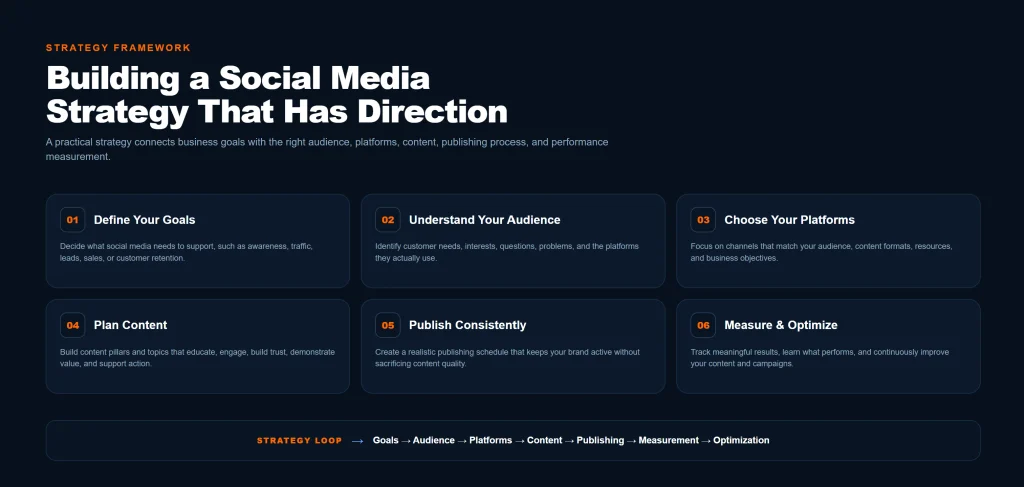
A social media strategy turns individual posts and campaigns into a coordinated system.
Step 1: Define Business Goals
Start with the outcome the business wants to achieve.
This might be:
- Brand awareness
- Website traffic
- Lead generation
- Product sales
- Customer engagement
- Community building
The goal should influence everything that follows.
Step 2: Identify the Target Audience
Define who the business is trying to reach.
Consider:
- Customer needs
- Problems
- Buying motivations
- Questions
- Interests
- Platform behavior
The more clearly the audience is understood, the easier it becomes to develop relevant content.
Step 3: Select the Platforms
Choose platforms based on audience, content format, business objectives, and available resources.
There is no requirement to maintain every platform.
Step 4: Define Content Pillars
Create a small number of recurring topics that support the business’s positioning and audience needs.
These pillars provide structure while leaving enough flexibility for individual content ideas.
Step 5: Create a Publishing System
Determine:
- What will be published
- Where it will be published
- Who creates it
- Who approves it
- When it will be published
- How performance will be tracked
A clear workflow reduces the risk of inconsistent publishing.
Step 6: Establish the Content Workflow
A typical workflow might look like:
Research → Planning → Creation → Review → Publishing → Engagement → Measurement
This makes social media less dependent on random inspiration.
Step 7: Launch and Monitor
Once the strategy is active, monitor both content and audience response.
Look for patterns rather than judging the entire strategy from one post.
Step 8: Measure Results
Compare performance against the original objectives.
Lead generation campaigns should be measured by the number and quality of leads generated.
Brand awareness campaigns can focus on reach, impressions, engagement, and growth among the target audience.
Sales-focused campaigns should prioritize conversions, revenue, customer acquisition cost, and overall return on marketing spend.
Step 9: Improve Based on Performance
Social media strategy should evolve.
Businesses can adjust:
- Content topics
- Formats
- Platforms
- Publishing frequency
- Creative direction
- Targeting
- Campaign budgets
The objective is continuous improvement rather than finding a permanent formula.
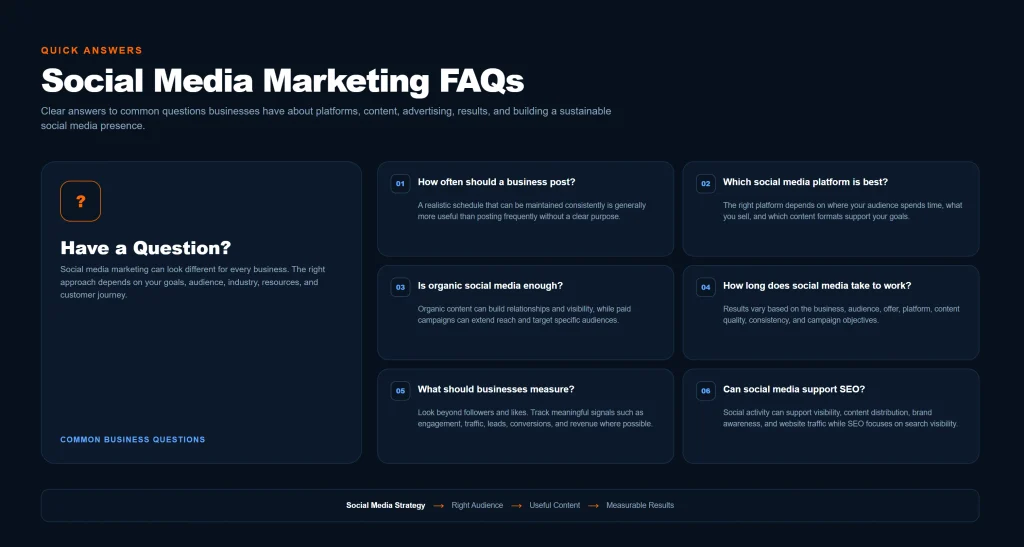
Social Media Marketing FAQs
What is social media marketing?
Social media marketing is the use of social media platforms to promote a business, distribute content, build relationships with audiences, and support business objectives such as awareness, traffic, leads, or sales.
It can include organic content, paid advertising, community management, content strategy, and performance measurement.
Why is social media marketing important for businesses?
Social media can help businesses become more visible to relevant audiences, communicate their value, demonstrate expertise, build familiarity, interact with customers, and support broader marketing campaigns.
Its value depends on how well the strategy connects social activity to actual business objectives.
Which social media platform is best for business?
There is no single platform that is best for every business.
The appropriate platform depends on the target audience, business model, content format, resources, and marketing objectives.
A business should prioritize platforms where its audience is relevant and where it can consistently produce useful content.
How often should a business post on social media?
There is no universal posting frequency that guarantees results.
The appropriate frequency depends on the platform, audience, content resources, business objectives, and ability to maintain quality.
Consistent, useful content is generally more valuable than publishing large amounts of low-quality content simply to increase posting frequency.
Is organic social media marketing still effective?
Organic social media can remain useful for building familiarity, communicating with existing audiences, sharing educational content, and developing relationships.
However, organic distribution is not guaranteed to reach every potential customer.
Businesses may use paid campaigns when they need additional reach or more controlled audience targeting.
Is paid social media advertising necessary?
Not every business needs paid social advertising for every objective.
Paid campaigns can be useful when a business wants to reach specific audiences, promote an offer, generate leads, increase website traffic, or support sales.
The decision should be based on the campaign objective and economics rather than assuming paid promotion is always required.
How much does social media marketing cost?
Social media marketing costs vary depending on the scope of work.
Factors can include:
- Number of platforms
- Content volume
- Creative requirements
- Video production
- Community management
- Advertising spend
- Campaign complexity
- Reporting
- Strategy and consulting
Organic management and paid advertising also involve different cost structures.
Can social media marketing help SEO?
Social media and SEO have different primary functions.
Social media can help distribute content, increase awareness, and introduce people to a business and its resources.
SEO focuses on visibility in search engines.
The two channels can therefore support the broader marketing system without being treated as interchangeable.
How long does social media marketing take to produce results?
The timeline varies by business, audience, platform, content quality, campaign objective, and whether paid advertising is involved.
Some campaigns can generate immediate interactions or traffic, while building brand familiarity, audience relationships, and consistent organic performance can take considerably longer.
Businesses should evaluate progress using measurements appropriate to their objectives.
What should a business post on social media?
Content should be based on the audience’s needs and the business’s objectives.
Useful categories can include:
- Educational content
- Product or service information
- Demonstrations
- Case studies
- Testimonials
- Short-form video
- Behind-the-scenes content
- Industry insights
- Promotional content
The strongest content strategies usually combine multiple formats and purposes rather than repeating the same type of post.
Should businesses use every social media platform?
No.
Businesses should choose platforms based on where their target audience is active, what content they can produce effectively, and which platforms support their business objectives.
Maintaining fewer platforms effectively can be more useful than maintaining many platforms poorly.
Build a Social Media Strategy That Supports Your Business Goals
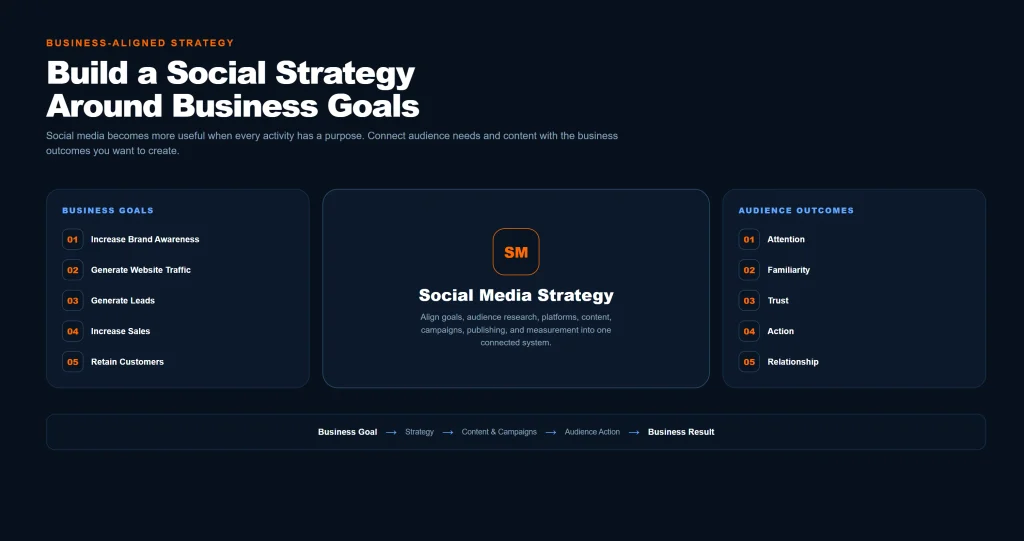
Social media should not exist simply because every business is expected to have an active profile.
It should have a purpose.
A well-planned social media strategy can help a business attract attention, become familiar to potential customers, demonstrate expertise, communicate its products or services, and create opportunities for meaningful action.
But social media works best when it is connected to the rest of the marketing system.
SEO can capture people searching for information or services. Google Ads can reach people with stronger immediate intent. A website can provide detailed information and conversion paths. Social media can help introduce the brand, distribute content, and maintain familiarity throughout the customer journey.
The goal is not simply to publish more content. It is to make each part of the social media system support a clear business objective.
Businesses that want a structured approach to social media strategy, content, campaigns, and ongoing growth can explore our Social Media Marketing Services.